Brief · Comparison
PayID vs Crypto: What the Numbers Show
Together, PayID and cryptocurrency handle most Australian pokies deposit volume in 2026. They optimise for different things. This brief presents the observable differences from the Q1 2026 test panel.
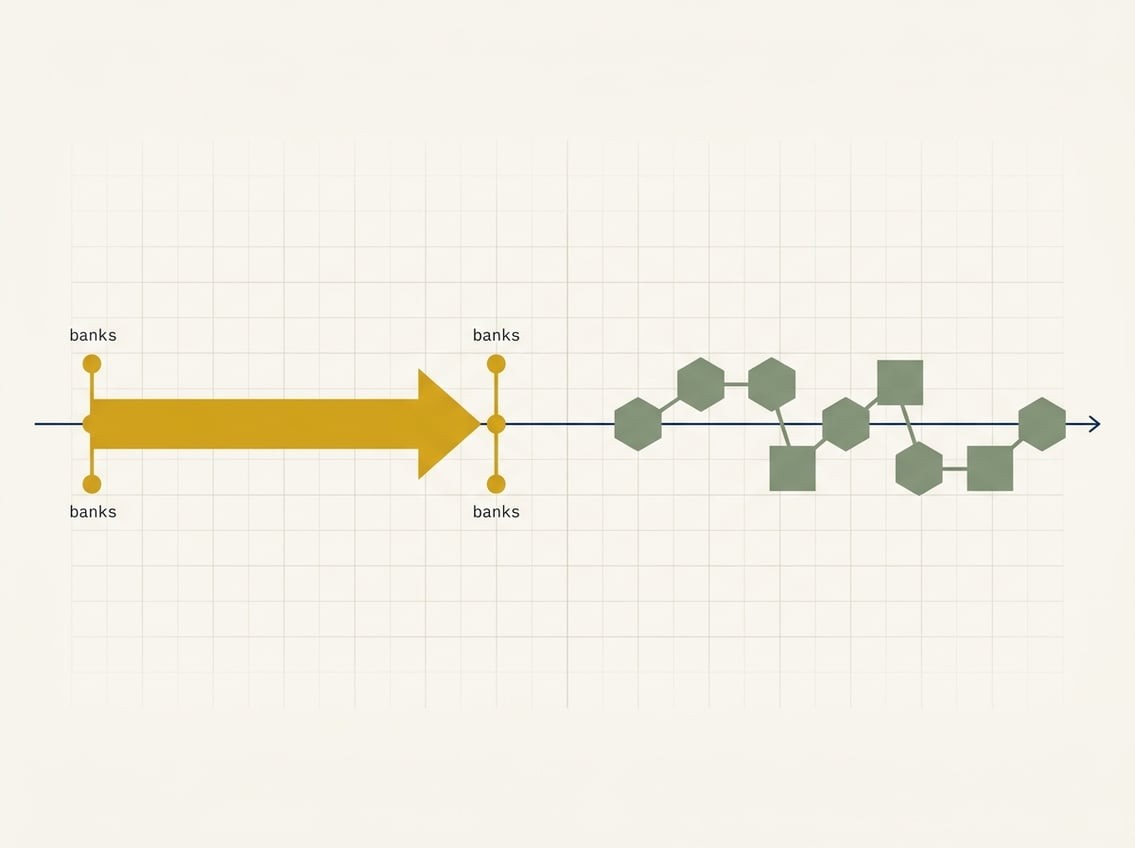
Cryptocurrency and PayID both emerged as replacements for card in Australian-facing offshore pokies deposits, but they solve different problems. PayID solves for domestic-rail speed and integration with the Australian banking system. Crypto solves for censorship-resistance and cross-border settlement in currencies that are not subject to the same acquiring-bank frictions as AUD-denominated card transactions. This brief describes the observable differences on payid pokies deposits versus crypto deposits at the same set of operators.
What "crypto deposit" actually means in this context
The overwhelming majority of crypto pokies deposits at Australian-facing operators are made in USDT (Tether), USDC, or Bitcoin. USDT dominates by a wide margin. Deposits are typically made from a self-custodied wallet or from a centralised exchange account to an address supplied by the operator, on one of several supported blockchains — Ethereum, Tron, or the Bitcoin Lightning Network for BTC.
The rail is materially different from PayID at every layer. There is no bank on either side, no confirmation-of-payee prompt, no domestic settlement system, and no Australian consumer-protection framework governing the transfer itself. What the two rails share is that they both terminate in a balance credited to the player's operator account, and both can — under some conditions — clear inside minutes.
The three chains that dominate
Tron-USDT dominates crypto pokies deposit volume for one primary reason: transaction fees are near zero and confirmation times are near-instant relative to Ethereum or Bitcoin. A Tron-USDT deposit typically costs the sender less than a dollar in network fees and confirms within a minute. Ethereum-USDT deposits are functionally similar but cost several dollars in gas and take longer. Bitcoin — either on-chain or via Lightning — represents a smaller share of volume, dominated by players with existing BTC positions rather than by players buying crypto specifically to deposit.
The wallet-side variation
The player-side experience of crypto deposits varies enormously with the wallet used. A player with an established self-custody wallet configured for the right chain can complete a deposit in under a minute. A player who needs to buy crypto on an exchange, transfer it to a wallet or send it directly from the exchange to the operator, may need thirty minutes or more end-to-end. This variation is not captured in the on-chain settlement metrics but matters for user experience.
Settlement time, compared
Fig. 01
Median deposit settlement time by rail, Q1 2026 panel
Source: Signal Room Q1 2026 test panel; n=240 PayID, n=52 crypto deposits split across chains. Times measured from wallet-side transaction broadcast to operator-side balance credit.
Crypto settlement varies by blockchain. USDT on Tron and Lightning-network BTC are competitive with PayID's speed; USDT on Ethereum and on-chain BTC are notably slower. Operators typically require a specific number of confirmations before crediting a deposit — this operator-side confirmation policy is often what dominates the tail rather than any inherent property of the chain.
Volatility exposure
PayID transfers are AUD-denominated at both ends. The player deposits AUD, the operator receives AUD (converted internally), and any withdrawal returns AUD. There is no exposure to currency volatility during the transaction itself.
Crypto transfers are chain-native-token-denominated. A player depositing 100 USDT and immediately playing is exposed to the USDT-AUD rate at the deposit moment; a player withdrawing crypto later is exposed to the USDT-AUD rate at the withdrawal moment. For stablecoin deposits over short time horizons the exposure is small. For BTC or ETH deposits, or for balances held across days or weeks, the exposure is potentially large. This is not a hypothetical risk; the Q1 2026 panel included one BTC deposit that lost 6.3 per cent to price movement between deposit confirmation and same-day withdrawal.
Stablecoin de-pegging as a tail risk
Stablecoins are engineered to hold their peg but do not always succeed. USDT lost peg materially during 2022 and briefly again in 2023; USDC lost peg during the Silicon Valley Bank episode in March 2023. Peg breaks are typically resolved within hours to days but are non-zero-probability events. A player holding significant balances in USDT or USDC across a peg break can lose meaningful value on stable-denominated funds. PayID has no equivalent exposure — an AUD balance in an Australian bank is an AUD balance.
Cost structure
The cost structures diverge notably.
PayID: FX spread as the dominant cost
PayID's costs are entirely at the operator layer, imposed as FX spread on the AUD-to-settlement-currency conversion. Round-trip typical cost sits at 2 to 8 per cent depending on operator generosity with the FX rate.
Crypto: network fees plus spread on the fiat conversion
Crypto costs are split. On-chain network fees vary by blockchain — Tron sits near zero (sub-dollar), Ethereum ranges from a few dollars to tens of dollars depending on congestion, Bitcoin varies with mempool state. On top of network fees, the player pays a spread to get from AUD to crypto (buying on an exchange) and back from crypto to AUD (selling on an exchange), each typically 0.5 to 1.5 per cent at reputable venues.
Total crypto round-trip cost varies wildly. A player using USDT on Tron with a low-spread exchange might pay 1-2 per cent. A player using on-chain BTC through a retail exchange at high volatility might pay 5-8 per cent. The variance is much higher than PayID's.
Failure modes, compared
PayID fails in two ways: the rail declines the transfer (rare, and self-correcting) or the operator fails to reconcile the credit (recoverable via support). Crypto fails in more varied ways.
Wrong-chain sends
USDT exists on multiple blockchains (Ethereum, Tron, BSC, others). Sending USDT to a Tron address from an Ethereum-network transaction results in permanent loss of the funds; the receiving address does not exist on the receiving chain. Reputable operators warn against this at the deposit step; a small percentage of users still make the error. This has no PayID equivalent.
Insufficient confirmations at cashout
An operator that requires six BTC confirmations before crediting is holding the deposit for approximately an hour. A player who deposited near the end of a session and then tried to play immediately may find their balance not yet available. This is a UX issue as much as a settlement one.
Exchange withdrawal delays
Getting crypto back to AUD requires an exchange withdrawal, which involves its own KYC and its own approval queue. The rail may clear in minutes but the fiat-conversion step can add hours or days. PayID has no analogous step; the withdrawal is already AUD.
Compliance overhead on the player side
The compliance burden differs meaningfully. PayID transfers happen inside the sender's normal Australian banking arrangement and generate the standard transaction record. No additional player-side reporting is created; the bank statement is the record.
Crypto activity generates records at multiple points — the on-ramp exchange purchase, the wallet-to-operator transfer, the eventual off-ramp back to AUD. Each transaction has an AUD-equivalent value at time of transaction, and the ATO's guidance treats crypto as a capital-gains asset. A player who buys 500 USDT for AUD 780, plays and wins, and withdraws 550 USDT worth AUD 872 has generated a capital-gains event at the time of sale that requires reporting. Whether this is a net negative for a player depends on their tax situation; that it is an additional record-keeping burden is not in dispute.
Practical record-keeping
Signal Room's view is that crypto-based gambling activity generates enough compliance overhead — exchange records, wallet transaction histories, per-transaction AUD conversions — that many players underestimate the effort of doing it correctly. PayID activity requires only the bank statement, which is already generated automatically. The compliance-overhead differential is a real, if underappreciated, factor in the two rails' user experiences.
Crypto's rail is fast; the round-trip to AUD is not always fast. PayID's rail and its round-trip to AUD are the same journey. — From this brief
Reversibility and dispute resolution
Neither rail supports reversibility. Once a PayID transaction settles, it is settled. Once a crypto transaction confirms on-chain, it is confirmed. Neither has a scheme-level chargeback mechanism analogous to card.
The dispute-resolution paths differ. A PayID dispute goes to the operator, and failing that, to the operator's licensing regulator or, in rare cases, to ASIC if the operator has an Australian nexus. A crypto dispute goes to the operator, and failing that, to the operator's licensing regulator — but any Australian consumer-protection framework generally does not apply because the transaction has no domestic-rail leg.
In practice, a player disputing a crypto transaction with an offshore operator has fewer recovery paths available than a player disputing a PayID transaction with the same operator. The absence of an Australian rail leg means that Australian regulatory bodies with a partial jurisdictional interest — the payment side sits under ASIC in the PayID case — simply do not appear in the crypto case. The dispute lands entirely at the operator's licensing authority, whose responsiveness and enforcement capacity varies enormously by jurisdiction.
Regulatory posture
PayID transfers are domestic Australian banking transactions and are governed by the full stack of Australian financial regulation: NPP Australia rules, RBA oversight, ASIC consumer protection, AUSTRAC AML obligations on the sending bank. Crypto transactions, by contrast, exist within an evolving regulatory framework. AUSTRAC-registered crypto exchanges apply KYC and AML monitoring; wallets and on-chain transfers themselves are outside direct Australian regulation.
For pokies specifically, the ACMA's remit covers the gambling activity regardless of payment rail. Operators are on notice for offering services to Australian residents whether they accept PayID, crypto, or both. The rail choice does not materially change the enforcement picture at the gambling layer.
Sanctions and travel-rule considerations
AUSTRAC's travel-rule guidance, aligned with the FATF's recommendation 16, requires Australian-registered virtual-asset-service providers to collect and transmit originator and beneficiary information on crypto transfers above AUD 3,000. This is implemented at the exchange layer, not at the wallet layer, and applies to on-ramp and off-ramp transactions rather than to pure wallet-to-operator transfers. Players moving significant amounts through exchange-hosted crypto wallets should expect their exchange to comply with these obligations as part of its standard operations.
The overall enforcement asymmetry
Australian enforcement on the gambling side falls primarily on operators — with ISP-level site blocking, payment-processor pressure, and periodic public warnings — rather than on individual players. This is consistent across payment rails. What differs is the visibility of the transaction to authorities: a PayID transfer sits in bank records that are subject to standard Australian legal process; a crypto transfer sits partly at exchanges (subject to similar process) and partly on-chain (permanently pseudonymous but analytically traceable). Neither offers meaningful privacy from a determined regulator.
Common questions
If crypto is on average slightly cheaper for round-trips, why does PayID lead on volume?
Familiarity, absence of volatility exposure, and integration with Australian banks. Crypto's cost advantage on Tron-USDT is real but small, and it disappears entirely for players using retail exchanges or on-chain BTC. For the median Australian player, PayID's zero-friction fiat-native flow outweighs a marginal cost saving.
Does using crypto give me any privacy benefit relative to PayID?
Modest, if any. AUSTRAC-registered exchanges have full KYC on the players buying and selling crypto, and their records are available to Australian authorities under standard legal processes. The on-chain leg of the transaction is pseudonymous but not anonymous, and address clustering is routine. PayID's data trail is legible to the sending bank and, via that bank, to authorities under the same processes.
Should I be worried about depositing via crypto to an operator that doesn't accept PayID?
Not by default. Some legitimate operators run crypto-first because their acquiring banks make PayID processing costly. That said, an operator whose only rails are crypto has narrowed its regulatory footprint in a way that reduces player recourse. Extra due diligence is warranted before committing significant amounts.
What's the effect on withdrawals — is crypto faster to get money back?
On the rail, yes — a well-run operator can release a crypto withdrawal inside minutes. Getting from crypto to AUD in an Australian bank account adds the exchange withdrawal step, which typically takes hours to a business day. PayID withdrawals arrive in an AUD bank account directly, without an intermediate step, and are faster end-to-end for most players in most cases.
Responsible gambling
18+Analysis for Australian adults. Not advice, not an endorsement of gambling.
Gambling Help Online — 1800 858 858 (free, 24 hours, anonymous). Lifeline 13 11 14.