Brief · Comparison
PayID vs Credit Card: A Side-by-Side Comparison
The two rails compete for what remains of the Australian pokies deposit market. This brief presents the empirical differences — settlement time, cost, failure rate, security posture — with the panel data behind each.
The comparison between PayID and credit card as pokies deposit rails looks straightforward at first glance — one is faster and cheaper, the other more familiar. The reality is more nuanced, and the trade-offs are not the ones the marketing surfaces. This brief works through the observable differences on payid pokies transactions relative to credit card transactions at the same operators.
What each rail is, structurally
PayID sits over the New Payments Platform, an Australian domestic real-time gross settlement system operated by NPP Australia and connected to all major and most minor Australian banks. Transfers move directly between bank accounts. There is no intermediary card scheme, no merchant acquirer, no card issuer sitting between sender and recipient at the payment-network layer.
Credit card transactions to gambling operators typically route through international card schemes (Visa or Mastercard predominantly), with an offshore acquiring bank on the operator side and the Australian issuing bank on the player side. The transaction is authorised at the issuer, processed by the scheme, settled by the acquirer, and reconciled by the operator. Any of these layers can decline or delay the transaction.
Settlement time, compared
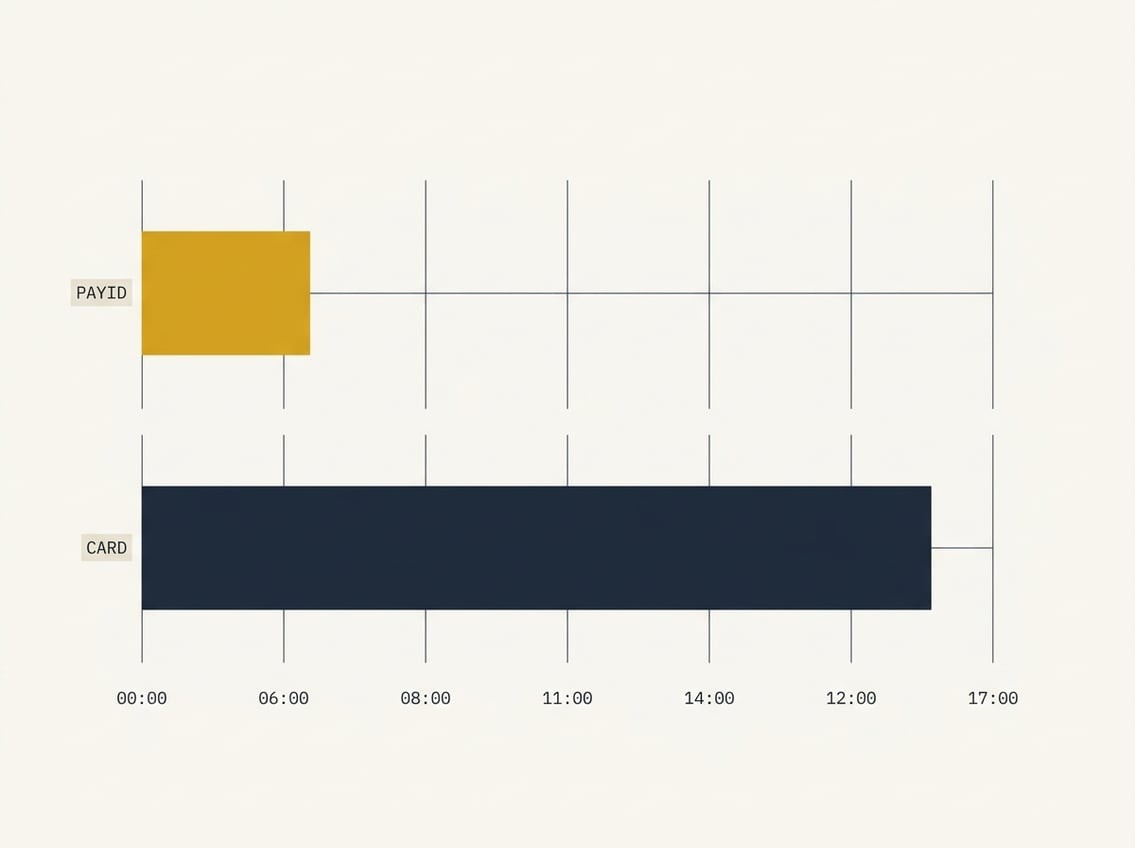
The most visible difference is settlement time. PayID's median deposit clears in under two minutes across the Q1 2026 test panel. Credit card, when accepted, clears within a range dominated by three-D-secure prompts, issuer risk-scoring, and merchant processing batches.
Fig. 01
Median deposit settlement time by rail, Q1 2026 test panel
Source: Signal Room Q1 2026 test panel; n=240 PayID successful, n=42 card approved, n=53 card declined. Card median calculated on approved subset only.
The card median of 11 minutes obscures a bimodal distribution: cards that clear promptly cluster around 3-5 minutes, and cards that hit additional review sit closer to 20-30 minutes. There is no meaningful PayID analogue to the declined-card retry loop; PayID either settles or the funds do not leave the sender's account.
What drives the card tail
Three factors dominate the slow-card cases. First, three-D-secure prompts that require the player to authenticate through their bank's app or SMS code, which adds anywhere from thirty seconds to several minutes depending on user response time. Second, additional issuer risk-scoring on gambling-flagged transactions, particularly for first-time or unusual-amount attempts. Third, offshore acquirer processing batches, which can add up to ten minutes on top of the authorisation time.
What drives the PayID tail
The PayID tail is almost entirely operator-side. The rail itself moves funds inside seconds. The tail comes from operator reconciliation batches, from occasional reference-field mismatches requiring manual matching, and from support-side delays where a deposit sits in a review queue awaiting a human touch. None of these are common; when they occur, they extend an otherwise near-instant experience to something closer to card timing.
Failure rate, compared
The single largest quantitative difference between the two rails, in the Q1 2026 panel, was failure rate. Card failure — defined as an attempted transaction that did not result in the operator crediting the player's balance — sat at 14.3 per cent. PayID rail-layer failure sat at 2.1 per cent. This is not a marginal difference and it is not driven by user error.
Fig. 02
Failure rate breakdown by rail (deposit attempts, Q1 2026)
Source: Signal Room Q1 2026 test panel. Card failures attributed to layer based on decline response codes returned. PayID failures include both rail-layer and operator-reconciliation modes.
The dominant card-failure mode is issuer-level: Australian banks decline the merchant category code associated with the gambling acquirer. This is not a per-transaction risk decision so much as a policy stance. Cards from the four majors decline at meaningfully higher rates than cards from neo-banks; some issuers refuse the category outright regardless of amount or history.
The neo-bank divergence
Panel data shows a clear split between the four majors and the neo-banks. Cards from CommBank, Westpac, NAB, and ANZ declined at rates between 12 and 21 per cent in the Q1 2026 panel. Cards from ING, Up, Macquarie, and other neo-banks declined at rates between 4 and 9 per cent. The difference reflects internal policy rather than any technical rail-layer distinction; the underlying card infrastructure is the same.
The soft-decline retry pattern
Some declined cards are "soft" declines — the issuer rejects the specific transaction attempt but would approve a subsequent attempt with slightly different parameters. Some players discover this by retrying and succeeding; others assume the first decline is definitive and abandon. Signal Room's panel measured retry-success rates of approximately 34 per cent on same-day retries of initially declined transactions, which is a large enough share to change the effective failure rate materially if retry behaviour is included.
Cost, compared
The rail-layer cost picture is closer than the settlement-time picture. PayID is nominally free to both parties at the interbank layer. Card carries interchange, scheme, and acquiring fees paid by the merchant, typically totalling 2-4 per cent of transaction value.
At the player layer, however, the cost pictures converge. PayID operators cover their processing costs through FX spread; card operators pass some of the interchange cost through to players via similar FX mechanisms or, in some cases, explicit "processing fees." Round-trip cost at typical operators sits at 2-8 per cent for PayID and 3-9 per cent for card, with wide overlap between them.
Where the card cost bump comes from
Card carries a genuine cost differential at the operator layer — roughly two to three per cent in interchange and scheme fees that PayID does not incur. Operators that pass this through to players do so through modestly less favourable FX rates, per-transaction "processing" line items, or reduced bonus generosity for card deposits. Operators that absorb it do so at the expense of margin on card-deposited players relative to PayID-deposited players.
The cash-advance question
An additional cost specific to card is the treatment of gambling transactions as "cash advances" by some Australian issuing banks. This designation triggers a higher APR from the moment of transaction (no interest-free period), a per-transaction cash-advance fee typically around three per cent or a minimum three dollars, and different rewards-programme treatment. A player using a rewards credit card for pokies transactions may find the effective cost materially higher than the operator-side spread alone would suggest.
Security posture, compared
The two rails differ meaningfully in security posture, though not in a single direction. PayID does not require the player to share a reusable credential with the operator; the sender's bank authorises each transaction with a biometric or PIN factor. Card requires the operator to store or tokenise the card number, expiry, and security code — which, if the operator's systems are compromised, exposes credentials that can be used elsewhere in the card network.
Card, however, offers the player something PayID does not: scheme-level chargeback rights. A player who is defrauded, misled, or supplied a service materially different from what was represented can dispute the transaction with their card issuer. The issuer will investigate and, in most legitimate cases, reverse the transaction. PayID has no equivalent mechanism. Once a PayID transaction settles, it is settled.
What chargeback actually covers
Chargeback rights are meaningfully narrower than most players assume. The scheme rules cover fraud (unauthorised use of the card), non-delivery (payment for a good or service that was never provided), and material misrepresentation. They do not cover gambling losses. A player who deposited, played, and lost cannot chargeback the loss; the transaction was authorised and the service was provided. The chargeback right exists but is not a rewind button on the activity itself.
Where PayID's irreversibility bites
The irreversibility matters most in operator-failure cases. If an operator refuses to release a withdrawal, becomes insolvent, or exits the market before paying out a balance, the player has no rail-layer mechanism to recover funds. With card, in some cases and for some transaction ages, the chargeback right may apply. With PayID, the only route is the operator's licensing authority — Malta Gaming Authority, Curaçao Gaming Control Board, or similar — whose responsiveness varies by jurisdiction and by dispute.
PayID reduces the credential-exposure risk; card retains the chargeback right. The two protect against different threats. — From this brief
Regulatory posture, compared
PayID operates under NPP Australia's rules and the Reserve Bank's payment-systems oversight. Consumer protection at the payment layer is under ASIC. Card operates under international card scheme rules, layered with Australian consumer protections that apply where the transaction involves an Australian issuer.
For pokies specifically, the ACMA has been vocal about card acceptance for gambling transactions, and the National Consumer Credit Protection Amendment (Prohibiting Gambling on Credit Cards) Act 2023 prohibits Australian-licensed operators from accepting credit card deposits. Offshore operators are not directly bound by this Act, but the tightening of card acceptance from Australian issuers has produced a similar effect indirectly.
User-experience differences worth naming
Beyond the quantitative measures, the two rails produce meaningfully different user experiences at the moment of deposit. PayID's confirmation-of-payee prompt surfaces the operator's registered name before the transfer is authorised — a small but real anti-fraud protection. Card's three-D-secure prompt does not perform the equivalent check.
PayID uses the player's banking-app biometric flow, which for most users is faster than typing card details. Card entry, particularly first-time, involves typing sixteen-digit numbers, expiry dates, and security codes; the manual overhead is real. After initial entry, saved cards behave similarly to saved PayID identifiers, though card credential storage carries the security implications noted above.
The saved-credential asymmetry
A saved card at an operator represents a durable authorisation to charge the player again. A saved PayID identifier at an operator represents nothing more than a memorised address. The operator still needs the player to initiate each PayID transfer through their banking app; there is no mechanism for the operator to pull funds from the player's account. This asymmetry has downstream effects on how operators run their in-session deposit prompts, their auto-topup features, and their bonus mechanics — each of which behaves differently on the two rails.
Which fails better, when it fails
Not all failure is equal. When PayID fails at the rail layer, the funds do not leave the sender's account; the failure is silent and self-correcting. When PayID fails at the reconciliation layer, the funds have moved but are not yet credited; the resolution path is a support ticket with a reference number, usually resolved within a business day.
When card fails, the transaction is declined at some layer, and the failure is visible to the player. There is no funds-in-transit state to resolve. This is arguably a better failure mode for the player — the decline is quick and clear — even though it results in a higher failure rate overall.
The one operator-side factor worth flagging
Operators receiving PayID deposits face different fraud and compliance obligations than operators receiving card deposits. Card comes with scheme-imposed chargeback risk; if a player disputes and wins, the operator loses the funds and typically the merchant fee. PayID has no such mechanism, which shifts the operator's cost structure and, importantly, their incentive to resolve player complaints outside a chargeback pathway. This is not necessarily bad for players — many operators respond faster to complaints because they cannot rely on chargeback timelines — but it changes the shape of dispute resolution.
What this means for operator selection
Operators that historically relied on the chargeback timeline to slow-walk complaints have had to adapt to a PayID-dominant deposit mix. Some have adapted well — front-loading verification, improving support responsiveness, and treating dispute resolution as a customer-retention question rather than a defensive posture. Others have not adapted and continue to run the same complaint-management processes designed for the card era, with predictably worse outcomes for players. The signal is observable from the outside: operators with fast, responsive support during withdrawal disputes are usually the ones that have made the adjustment.
Common questions
If PayID is faster and has lower failure, why does anyone still deposit with a card?
Familiarity, chargeback rights, and habit. For players who have used cards for years across many merchant categories, the mechanism is well understood. The chargeback right is a genuine consumer protection that PayID cannot match. And some operators still offer card as an option even where they prefer PayID for their own margin reasons.
Does using PayID instead of card give the operator any additional information about me?
Not materially. Both rails identify the sender to the operator — card by name-on-card and issuer, PayID by name-on-account. Neither hands the operator more than they need for reconciliation. PayID does not share your account balance, transaction history, or any other bank-held information with the operator.
Can I use the same bank account for both PayID and card at the same operator?
Yes. There is no cross-rail restriction. Whether the operator's terms allow both is a per-operator question, but the underlying financial arrangement supports it. Some operators lock a player to a single payment method to simplify AML tracking, which is a policy choice by the operator, not a rail constraint.
Is the PayID/card difference expected to persist, or will one rail displace the other entirely?
Displacement toward PayID has been steady and looks unlikely to reverse. Card processing to gambling merchants has become progressively harder for the reasons named above, and the trend is one-way. Signal Room expects card volume to continue shrinking as a share of Australian pokies deposits through 2026 and 2027.
Responsible gambling
18+This brief is analysis for Australian adults. Not advice, not an endorsement of gambling.
Gambling Help Online — 1800 858 858 (free, 24 hours, anonymous). Lifeline 13 11 14.