Brief · Technical walkthrough
How PayID Deposits Actually Clear
A step-by-step walkthrough of what happens between the moment you tap "deposit" and the moment your operator balance shows the new funds — through every layer, at every actor.
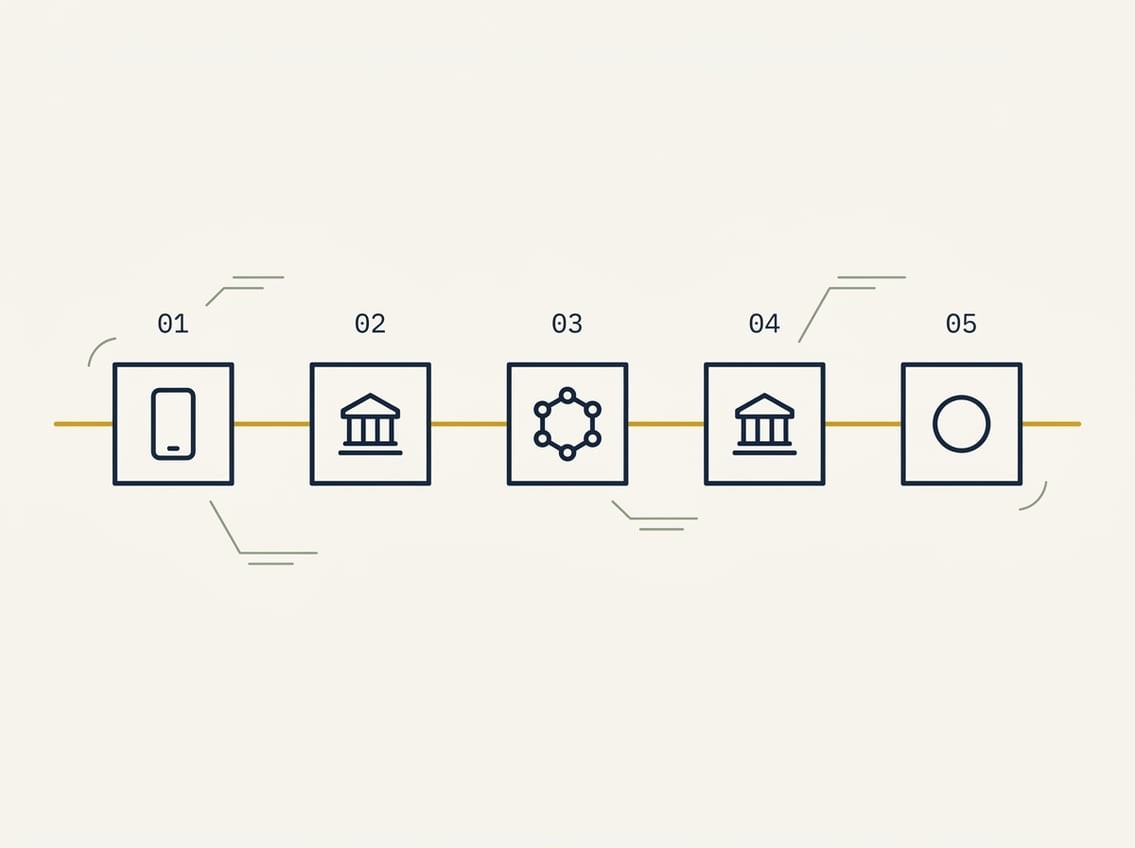
Most players interact with the PayID pokies deposit as a single-tap action. The mechanism underneath is not simple. Understanding it helps diagnose failure modes, explain settlement-time variance, and interpret operator communications about deposits sitting in review. This brief walks through the full lifecycle of an payid pokies deposit at a typical operator, layer by layer.
The five actors involved
Five actors participate in a completed deposit. The player. The player's sending bank. The New Payments Platform, operated by NPP Australia. The operator's receiving bank. The operator itself.
Each has a role, an information set, and a set of controls it can apply to the transaction. The controls are exercised at specific moments in the sequence. Understanding which actor holds control at each moment tells you where a stalled or failed deposit is stuck.
A useful mental model: the transaction is a baton passed between five actors. The player initiates, hands off to the sending bank, which hands off to the NPP, which hands off to the receiving bank, which hands off to the operator, which hands off back to the player through the balance display. Delays are almost always at the handoff, not inside any actor's own processing.
Step 1: Player initiates the deposit
The player, logged into the operator's cashier, selects PayID as the deposit method and enters an amount. The operator's system generates a PayID identifier — typically an email address or ABN registered to the operator's receiving bank — and a unique reference field to identify this specific transaction.
The player then opens their banking app, selects "Pay someone" or the equivalent, enters the PayID identifier, the amount, and the reference field, and taps to confirm.
What the operator has done so far
The operator has generated a "pending deposit" record on its side. This is not yet a deposit; it is an expectation that a payment matching the reference will arrive shortly. The operator's system will hold this record open for a specified time, typically 15 to 60 minutes, after which it will expire.
Why the reference field matters
The reference field is the mechanism by which the incoming NPP transaction is matched to the pending deposit record. Get the reference wrong — mistype it, use last transaction's reference, or omit it — and the operator's reconciliation system will not automatically match the deposit. The funds still arrive at the operator's bank account, but crediting the player's balance requires manual intervention. This is one of the more common causes of "my deposit didn't arrive" support tickets.
Step 2: Sender's bank runs pre-transfer checks
Before authorising the transfer, the player's bank performs several checks. The most visible is the confirmation-of-payee lookup: the bank queries NPP Australia's PayID registry with the entered identifier, retrieves the registered account name, and surfaces it to the player. The player is asked to confirm that the name matches expectation.
Behind this, the bank runs its own fraud-scoring engine. This considers factors like whether the recipient PayID has been paid before by this sender, the transaction amount relative to the sender's typical activity, the time of day, the sender's device fingerprint, and (increasingly) whether the recipient PayID is flagged in the bank's internal gambling-merchant classification. Depending on the risk score, the bank may allow the transfer, require additional authentication, block the transfer entirely, or require a cooling-off period.
Where the "confirmation of payee" changes decisions
A meaningful minority of players abandon the transaction at the confirmation-of-payee step. The name shown is often the operator's registered corporate name, which is not always the brand name the player recognises. A player expecting to see "BrandName Casino" and seeing "Chelmerston Operations Pty Ltd" instead may — reasonably — hesitate. Signal Room's panel measured a 3.8 per cent abandonment rate at this step.
Step 3: NPP routes the transfer
Once the sender confirms, the sending bank submits the transaction to the New Payments Platform. The NPP settles the transfer between the sending bank's and receiving bank's accounts held at the Reserve Bank of Australia. This settlement is real-time and irrevocable; once the NPP processes the transaction, the funds have moved.
NPP processing is generally sub-second. The rail is designed for it. In production, the whole authorisation-to-settlement cycle typically completes inside three to five seconds for most transactions.
The role of the Reserve Bank
The RBA operates the Fast Settlement Service that underpins the NPP. Every participating bank holds an exchange settlement account at the RBA; the FSS moves value between these accounts in real time. This is a genuine central-bank-money settlement, not a promise between banks to reconcile later — an important structural property of the rail.
Step 4: Receiving bank credits the operator's account
The operator's receiving bank now holds the funds in the account associated with the PayID identifier. This is when the operator's bank account balance increases. The operator itself does not know this yet — its systems are separate from its bank.
The reconciliation gap
The gap between "funds in operator's bank account" and "funds credited to player's operator balance" is where the reconciliation infrastructure lives. The operator's banking-integration systems poll or receive push notifications from the receiving bank, identify incoming transactions by their reference field, and match them to pending deposits generated at Step 1.
Well-run operators poll every 10-30 seconds and use webhooks where the receiving bank supports them, resulting in reconciliation gaps of under a minute. Poorly-run operators batch this on 5- or 15-minute intervals, or, worst-case, run it as a scheduled job that only fires a few times per hour.
Why this matters more than any other single factor
The variance in Step 4 timing across operators is the single largest source of variance in end-to-end deposit clearing times. All other steps are functionally standardised — the rail is the same rail, sending banks behave similarly, receiving banks credit funds similarly. Step 4 is where operator engineering quality most visibly translates into player experience. An operator that has invested in real-time reconciliation infrastructure produces a fundamentally better deposit experience than an operator running batch jobs, and this shows up cleanly in the settlement-time percentiles.
Step 5: Operator credits the player's balance
Once the reconciliation system matches the incoming NPP transaction to a pending deposit, the operator's back-end credits the player's balance and marks the deposit record as completed. The cashier UI, which has been polling, surfaces the new balance to the player.
If the player is playing at this moment, some operators bring up an overlay confirming the deposit and offering to close the deposit modal; others just update the balance display silently.
The compliance review overlay
For a subset of deposits — first-time deposits from a new player, large-value deposits, deposits from a player whose activity patterns flag AML or responsible-gambling review — the crediting step is gated on a manual review. This review is invisible to the player except as a delay. The deposit sits between Step 4 and Step 5 for however long the operator's compliance team takes to clear it, which is typically minutes but can stretch to hours or a business day in edge cases.
Where deposits stall, and how to interpret the delay
Understanding this five-step sequence explains most delay patterns.
Delay at Step 2 (rare)
If the sending bank's fraud engine flags the transaction for review, the transfer may be paused for anywhere from a few seconds to several minutes while additional authentication is requested. This is visible to the player as a prompt in the banking app. It is not a common cause of delay unless the transaction is unusual.
No delay at Step 3
NPP routing is not a common source of delay. The rail is engineered for real-time operation and typically clears in single-digit seconds. When it does fail, the failure is total and self-correcting; the funds do not leave the sender's account.
Delay at Step 4 (common)
Receiving bank credit is generally near-instant, but the operator's polling or webhook infrastructure at Step 4 is where most non-trivial delays live. If an operator's reconciliation runs on a batch interval, the average deposit sits for half the batch interval before crediting; the worst case sits for the full interval.
Delay at Step 5 (rare, high-impact)
Where a deposit sits in review at the operator's compliance or AML team — typically because it is a first deposit from a new player, or a large-value deposit from a player with sparse history — the delay can be hours or, in edge cases, days. This is the tail of the settlement distribution.
Most delays live at Step 4 or 5 — the operator side. The rail itself is fast and consistent. — From this brief
How to interpret an operator's "your deposit is being processed" message
Operators' UX language is not always precise. "Being processed" typically means one of three things: the deposit hasn't yet been detected by reconciliation (Step 4 delay), it's been detected but sits in review (Step 5 delay), or the operator's UI simply hasn't polled recently and the balance is already credited but not yet displayed. A page refresh often resolves the third case.
If the message has been showing for more than fifteen minutes and the transaction has cleared the sending bank, the deposit is stuck between Steps 4 and 5. Support contact with the transaction reference is the appropriate response. Repeat deposit attempts should be avoided; they compound the reconciliation problem rather than solve it.
Common questions
If my deposit shows in my bank statement but not in my operator balance, where is it?
It has cleared Steps 1 through 4 but is stuck at Step 4 or 5. The funds are in the operator's receiving bank account; the operator has either not yet reconciled them, or has flagged them for review. Contact the operator's support with your transaction reference and expect a response within a business day.
Why does the confirmation-of-payee show a corporate name that isn't the operator's brand?
PayID registrations are held by the legal entity, not the brand. The operator's legal entity may be a corporate services company incorporated in Malta or elsewhere. The brand is a trading name, not the account holder. It is legitimate for these to differ; it is also legitimate to hesitate if the name looks nothing like anything the operator has disclosed.
How long should I wait before contacting support about a stuck deposit?
Fifteen to thirty minutes is a reasonable threshold for a normal transaction that has cleared the sender bank. Beyond that, the reference is worth surfacing to support. Most reconciliation delays resolve without intervention within an hour; delays longer than an hour usually require a support ticket to resolve.
Can I speed up a stuck deposit by making a second deposit?
No, and it will likely make things worse. A second deposit adds a second pending record and, if it clears while the first is stuck, may consume the operator's compliance-review capacity for both. Wait, and contact support with the reference from the first deposit.
Responsible gambling
18+Analysis for Australian adults. Not advice, not an endorsement of gambling.
Gambling Help Online — 1800 858 858 (free, 24 hours, anonymous). Lifeline 13 11 14.