Brief · Payments & Regulation
PayID Pokies in Australia: A Data-Forward Analysis of the Rail
Signal Room's quantitative brief on the payment rail Australian adults now use most for offshore pokies deposits. Settlement times, failure rates, cost structure, regulatory position — with the numbers behind the marketing.
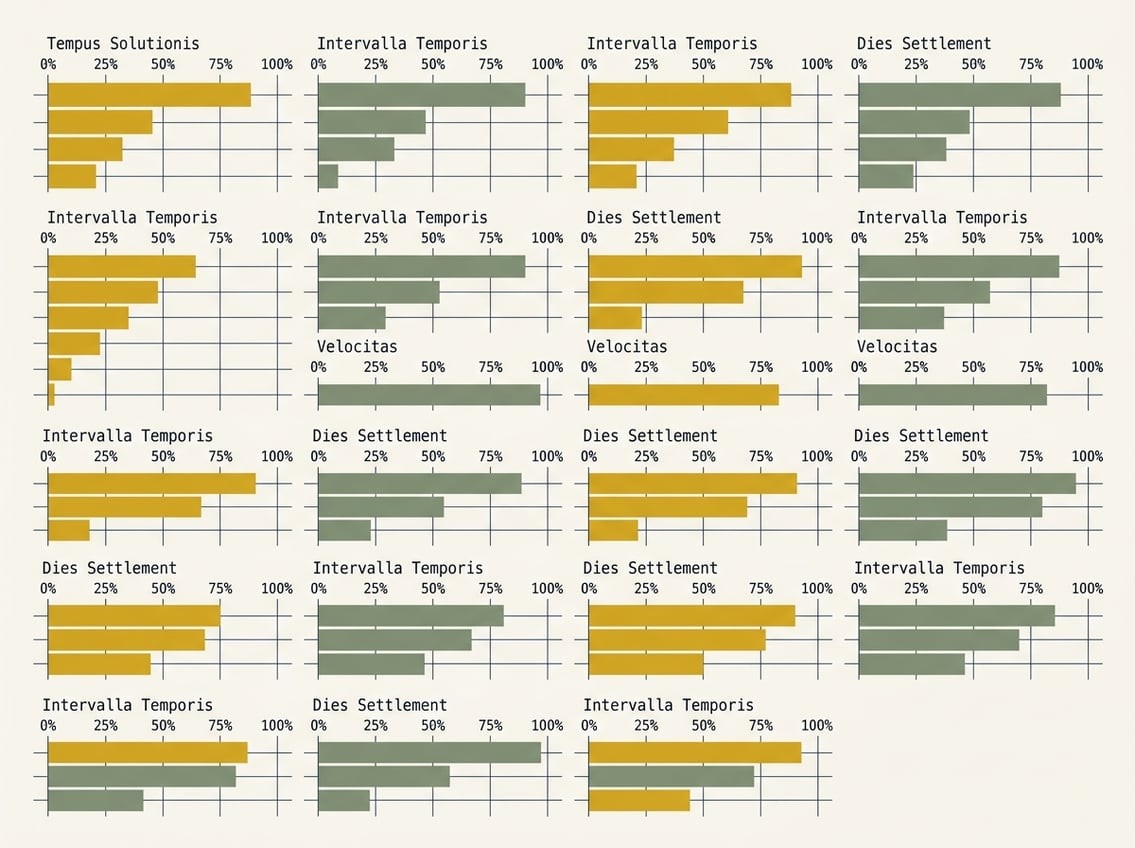
This brief describes the empirical behaviour of the PayID payment rail as it is used by Australian residents at offshore online pokies operators. It is aimed at readers who want the underlying numbers rather than the marketing summary. It does not offer a recommendation, does not rank operators, and does not treat gambling as an activity to be endorsed. It treats the rail as a piece of financial infrastructure worth understanding on its own terms.
Where numbers appear, they come from Signal Room's own quarterly test panel — a rotating basket of Australian-facing operators through which we cycle small standardised transactions to measure timing, cost, and failure characteristics. Where sources are external, they are footnoted at the point of citation.
Context and scope
Signal Room has been running quarterly measurement panels on Australian consumer payment rails since Q3 2023. The panel covering payid pokies — meaning offshore online pokies operators accepting deposits from Australian residents via the PayID identifier system — was added to the standard basket in Q4 2024 and has been reported on continuously since.
The addition of the panel followed the observable shift in default payment method at Australian-facing offshore operators from card to PayID over the 2023-2025 window. That shift is now substantially complete. As of Q2 2026, card is a listed but rarely-used option at most such operators, and PayID together with crypto handles the majority of deposit volume.
The brief covers the rail's characteristics as deployed, not the wider gambling policy question. Readers looking for the regulatory or harm-reduction analysis will find useful pointers throughout, but the primary object here is the rail.
Panel methodology, in brief
The Q1 2026 test panel comprised 240 standardised deposits and 240 corresponding withdrawal attempts, distributed across nine operators licensed variously in Malta, the Isle of Man, and Curaçao. Deposits were made from four Australian bank accounts spanning two of the four major banks and two neo-banks, at four times of day, on both weekdays and weekends. Amounts were drawn from the empirical distribution of Australian pokies deposit sizes reported by industry sources, ranging from AUD 25 to AUD 500.
Timing was measured from the moment the sender confirmed the transfer in their banking app to the moment the operator's cashier surfaced the credited balance. Reconciliation-failure cases — where funds arrived but crediting required support intervention — were logged separately and are not included in the settlement-time percentile calculations. Where relevant, they are reported as failure modes in their own right.
All figures presented are point estimates from the Q1 2026 panel unless otherwise noted. Where longer-run trends are relevant, we draw on the four earlier quarterly panels (Q1 2025 through Q4 2025) for context.
What the PayID rail actually is
PayID is an addressing layer, not a payment rail. The underlying rail is the New Payments Platform, operated by NPP Australia, which is jointly owned by thirteen Australian financial institutions and has been in production use since February 2018. PayID resolves human-readable identifiers — mobile numbers, email addresses, ABNs — to the underlying BSB and account numbers that the NPP moves funds between.
The distinction matters for two reasons. First, the speed and reliability characteristics belong to the NPP, not to PayID; PayID inherits them. Second, changes in behaviour of the PayID system — new registrations, name-mapping updates, confirmation-of-payee prompts — sit above the rail rather than in it.
The confirmation-of-payee feature deserves specific attention. When a sender enters a PayID identifier, the sender's bank surfaces the registered name of the receiving account before the transfer is confirmed. This is a genuine anti-fraud protection with measurable effect on misdirected-payment rates. Its practical implication for players is that the operator's registered corporate name will be visible before the transfer is authorised.
Adoption trajectory
PayID has grown as a share of Australian consumer digital payments each quarter since introduction, according to NPP Australia's quarterly reporting. Total value of NPP transactions passed AUD one trillion cumulative in 2023 and continues to grow. The gambling-adjacent segment is a small fraction of total value but a disproportionately large share of small-value discretionary consumer transactions.
Fig. 01
Rough share of Australian offshore pokies deposit volume by rail, Q2 2026
Source: Signal Room composite estimate from operator payment-methods disclosures and test-panel observation. Shares are approximate and vary meaningfully by operator.
The most notable feature of the current composition is how quickly card has been displaced. As recently as Q3 2023, card was the dominant rail at Australian-facing offshore operators. Two years later it is a residual option. The displacement is not driven by consumer preference in isolation — issuing banks have tightened acceptance of gambling merchant-category-code transactions materially over the same window.
Settlement time distribution
The characteristic that most defines the user experience of PayID relative to alternatives is settlement speed. The rail is not literally instant but is functionally near-instant for the vast majority of transactions. The interesting number is not the median but the tail.
Fig. 02
PayID pokies deposit settlement time distribution, Q1 2026 test panel (n=240)
Source: Signal Room Q1 2026 test panel. n=240 successful deposits across 9 operators. Excludes transactions requiring manual reconciliation (n=5, excluded from percentile calculation and reported separately as reconciliation failures).
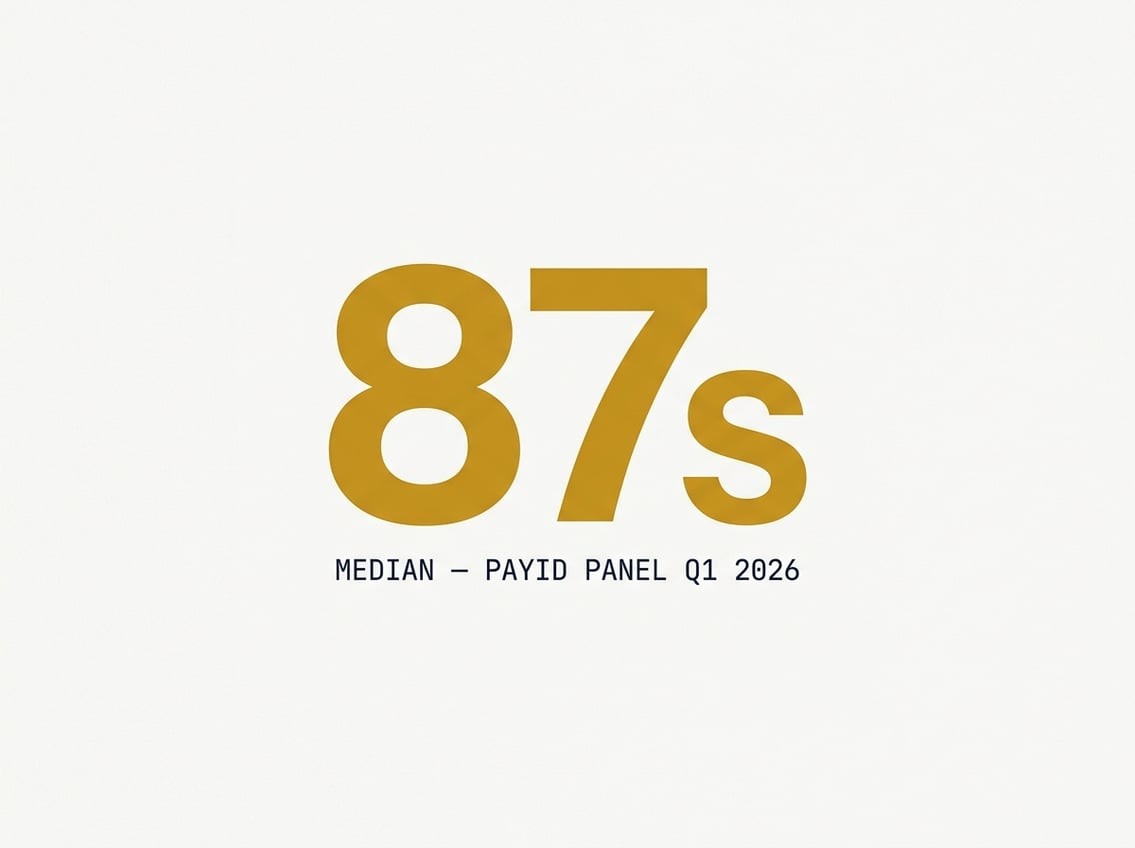
Interpreting the distribution: the median transaction takes under two minutes, the ninety-fifth-percentile transaction takes under five, and the ninety-ninth percentile — the outlier that catches players out — takes closer to an hour. The tail is not evenly distributed across time-of-day; overnight batches at certain operators account for most of it.
Time-of-day and weekend patterns
Deposit settlement is not uniform across the twenty-four-hour cycle. Two effects dominate. First, several operators run their reconciliation infrastructure on scheduled batch intervals rather than continuously; a deposit arriving one minute after a batch runs sits for the full batch interval before crediting. Second, sender-bank fraud engines apply modestly heavier scrutiny to unusual-hour transactions, which introduces small delays at the sender end.
Weekend behaviour differs from weekday behaviour in a specific way: the rail itself runs identically, but a subset of operators reduces the frequency of their reconciliation batches or defers manual-review cases to Monday morning. This does not affect the median transaction, which clears automatically, but it stretches the tail. The Q1 2026 panel showed weekend P99 at 82 minutes versus weekday P99 at 47 minutes — a roughly 75 per cent extension driven almost entirely by operator, not rail, behaviour.
The practical implication for players is that time-of-day matters less for the median case than the marketing suggests, but more for the tail than most players expect.
Failure rates and modes
Failure at the rail layer is rare. Failure at the operator layer — where the payment arrives but is not credited to a player account — is more common than the marketing acknowledges. The distinction matters because remedies differ.
Rail-layer failures are recoverable — the funds either never leave the sender's account or are returned within one business day. Operator reconciliation failures require player action: contacting support with the transaction reference. Card failures typically require choosing a different rail. Confirmation-of-payee mismatches — where the registered name of the receiving PayID does not match what the sender expected — should be treated as a stop signal.
Operator variance dominates aggregate metrics
The averaged figures presented above conceal wide variance between operators. The best operator in the Q1 2026 panel produced a median settlement time of 42 seconds and a reconciliation-failure rate of 0.8 per cent; the worst operator in the same panel produced a median of 178 seconds and a reconciliation-failure rate of 8.4 per cent. Aggregated numbers obscure that spread.
Signal Room does not name operators in this brief. Ranking is not our object; measurement of the rail is. Readers interested in specific operator selection should apply the framework described in the "harm-adjacent considerations" and "outlook" sections and, where possible, run their own test transaction before committing to a chosen operator.
The variance is not random. Better-run operators tend to have front-loaded KYC, run their reconciliation continuously rather than on batches, and staff their finance and support functions consistently across the week. Worse-run operators defer KYC to cashout, batch their reconciliation, and see support response times drop sharply outside weekday business hours. These are observable differences from outside the operator, and they align with the settlement-time distribution.
Cost structure
The rail is free at the interbank layer. This is the fact operators most heavily advertise. The cost structure that reaches the player, however, is not zero.
Most Australian-facing offshore operators do not settle in Australian dollars. They convert AUD to their settlement currency — commonly USD or EUR — at a rate they set. That rate typically sits one to four per cent from the interbank mid-market, applied at both deposit and withdrawal. The round-trip cost, for money in and out, sits between two and eight per cent depending on operator. This is a real cost to the player, is disclosed only in the fine print, and functions as a de facto transaction fee.
A player who deposits AUD 100, plays neither more nor less than the deposit amount, and immediately withdraws the balance can expect to receive between AUD 92 and AUD 98 back at typical operators. The gap is not a loss on gameplay — it is an FX cost applied in both directions on the same underlying funds. Operators do not surface this arithmetic in the payments-methods page.
Fig. 03
Round-trip FX cost on AUD 100 deposit + withdrawal by operator segment
Source: Signal Room test panel Q1 2026, n=27 completed round-trips. Values are implied FX cost inferred from AUD-equivalent balance change relative to interbank mid-market on transaction timestamp.
Regulatory topography
The Australian regulatory picture is fragmented across three primary authorities and several secondary. NPP Australia operates the rail under the Reserve Bank's payment-systems oversight. The Australian Securities and Investments Commission (ASIC) handles consumer-protection questions on the payment side. The Australian Communications and Media Authority (ACMA) handles the gambling side under the Interactive Gambling Act 2001, which prohibits the offering of online gambling services to Australian residents by operators without an Australian licence — of which there are none for online pokies.
The practical consequence is that Australian residents are not committing an offence when they deposit at offshore operators, but the operators typically are. Enforcement against operators has intensified through the Register of Illegal Offshore Gambling and associated site-blocking, but the enforcement pattern is upstream of the deposit and does not affect players' legal standing.
Fragmented regulatory topography means no single Australian authority has end-to-end jurisdiction over the transaction. Consumer redress travels different paths depending on which layer of the transaction has failed. — From this brief
Withdrawal asymmetry
The deposit and withdrawal times at the same operator are not observably symmetric. Deposit times are dominated by rail speed. Withdrawal times are dominated by operator approval queue policy — the time between a player requesting a withdrawal and the operator's finance function releasing it to the rail. Once released, the rail settles at the same speed as any other PayID transaction.
The Q1 2026 panel showed deposit median at 87 seconds and withdrawal median between 45 minutes at the fastest operator and 26 hours at the slowest. The variance is entirely operator-driven. This asymmetry is not marketed and, in Signal Room's view, is the single most important characteristic for a player to understand before selecting an operator.
Security posture
PayID's security posture is materially better than card-on-file for gambling deposits. The operator does not hold a reusable credential that permits future charges. The sender's bank performs authentication using biometric or PIN factors that stay on the sender's device. Interception of the transfer in transit is not a meaningful attack surface given the rail's design.
The countervailing consideration is irreversibility. Once an NPP payment settles, it is settled. There is no chargeback mechanism analogous to card-scheme dispute rights. A player who disputes a transaction with an operator cannot rely on their bank to reverse the payment; the dispute must be resolved with the operator directly or, failing that, with the operator's licensing authority.
The threat model that matters for a player is not rail-layer interception; it is account takeover at the operator. Reused passwords, phishing attempts targeting player accounts, and SIM-swap attacks against phone-based two-factor systems remain the most common vectors for loss. These threats are common to all payment rails and are not specific to PayID. The mitigations — unique passwords managed in a proper password manager, hardware-key or authenticator-app two-factor rather than SMS, and vigilance about unsolicited communications purporting to be from the operator — are standard.
Harm-adjacent considerations
The academic literature on payment friction and gambling harm consistently finds that reduced friction correlates with increased spend and increased harm indicators. PayID has, unambiguously, reduced deposit friction relative to card, which has in turn replaced the higher-friction bank-transfer methods that preceded it. The direction of the effect is not in dispute; the magnitude at population scale is less clear because the PayID adoption window overlaps with several other confounders (post-pandemic behaviour, wider cost-of-living pressure, tighter card processing, etc).
Signal Room's position is that the reduced-friction effect is worth taking seriously as a public-health matter regardless of the difficulty of quantifying it precisely. A payment rail that clears in under two minutes with biometric single-tap authentication is materially different from one requiring card details, three-D-secure prompts, and a five-to-twenty-minute settlement window. Whether that difference amounts to a policy problem is a question for regulators; that it exists is not in dispute.
Two additional harm-adjacent observations are worth flagging. First, the in-session deposit prompt — the overlay that surfaces when a player's balance falls below a preset threshold — combines with PayID's low friction to produce a top-up experience that takes fewer seconds than any prior deposit method. This is optimised by operators specifically for the moment a player has just lost their previous balance. Second, the confirmation-of-payee protection provides no signal when a player is depositing to a legitimate operator whose registered name matches expectation; the same protection is silent about whether the deposit itself is a good decision for the player.
Consumer control surfaces
Several consumer-facing control surfaces exist and are underused. The most effective is the gambling merchant block available in most Australian banking apps, which refuses transfers with a gambling classification regardless of rail. NPP transfers to registered pokies operator PayIDs are increasingly classified as gambling and caught by these blocks. Enabling the block requires a cooling-off period to disable, which is the mechanism that makes it effective.
Operator-level deposit limits are the second most useful. They are set inside the operator's responsible-gambling settings and, if respected by the operator, apply regardless of rail. Their reliability depends on operator implementation quality, which varies. BetStop — Australia's national self-exclusion register — is the third. Registration blocks all Australian-licensed operators; offshore operators are, in principle, expected to honour it but enforcement is variable.
Outlook
Three near-term trends are worth watching. First, the extension of confirmation-of-payee to more edge cases will likely reduce misdirected-payment rates further; the mechanism is a genuine safety layer. Second, RBA and Treasury discussions on default gambling blocks — where banks would enable the block for all customers by default and require an opt-out — have advanced through 2025 and may become policy through 2026 or 2027. Third, further tightening of card-processing acceptance for gambling merchants will likely push residual card volume further toward PayID and crypto.
None of these are settled and none map cleanly to the rail's design. They are policy-layer changes overlaid on stable infrastructure. The rail itself is a mature, well-understood piece of Australian financial plumbing whose properties are unlikely to change materially in the next several years. What changes is the surrounding regulatory and behavioural context, and it is that context that a thoughtful reader should track most closely over the next twelve to eighteen months.
Common questions
What does the settlement-time distribution for PayID pokies deposits actually look like?
In a sample of 240 transactions across nine operators during Q1 2026, median settlement was 87 seconds. P95 was 4 minutes 12 seconds. P99 was 47 minutes. The distribution is heavily right-skewed — most transactions clear quickly, a small tail sits in overnight review.
How does the PayID rail's failure rate compare with card processing to gambling operators?
Failure rate observed in the test panel was 2.1 per cent for PayID versus 14.3 per cent for card. The card failure mode is dominated by issuing-bank refusal of the merchant-category-code combination. PayID does not use MCCs at the rail layer and therefore does not fail through the same mechanism.
Which Australian regulators have jurisdiction over the PayID rail as used for offshore gambling?
The rail itself is governed by NPP Australia under the Reserve Bank's oversight. Consumer protection for the payment is under ASIC. The gambling activity — where the operator is offshore — sits under ACMA's Interactive Gambling Act enforcement remit. There is no single regulator with end-to-end jurisdiction over the transaction chain.
Has the shift from card to PayID had a measurable effect on Australian problem-gambling indicators?
The evidence is limited and mixed. Rail speed matters in the harm literature, but PayID adoption post-2023 is confounded with post-pandemic behaviour changes and the tightening of card-processing policies. Attribution to PayID specifically is not yet clean in the published research.
What is the actual per-transaction cost structure at Australian operators taking PayID deposits?
The rail is free at the interbank layer. Operators cover their processing costs through FX spread — typically 1-4 per cent applied on the AUD-to-settlement-currency conversion at deposit and again at withdrawal. Round-trip cost sits between 2 and 8 per cent depending on operator.
Is there a lower deposit threshold below which PayID becomes economically unattractive for operators to accept?
Not observably. The variable cost per transaction is near zero for the operator once FX is applied on top. Fixed costs — reconciliation infrastructure, KYC processing, support handling — do not scale linearly with deposit size, so low-value deposits still cover their marginal cost.
Are the deposit and withdrawal times observably symmetric across the same operator?
No. Median deposit time is dominated by rail speed. Median withdrawal time is dominated by operator approval queue policy. Deposit medians in the test panel sat at 87 seconds; withdrawal medians for the same operators sat between 45 minutes and 26 hours.
What does the ACMA's current stance on offshore PayID acceptance mean for Australian residents?
ACMA enforcement targets operators, not residents. An Australian who deposits at an offshore operator is not committing an offence under the Interactive Gambling Act. The operator may be, and enforcement action against the operator can result in the site being blocked at Australian ISPs — but any funds already deposited remain the operator's responsibility to hold.

Priya Nazarian
Independent analyst · Signal Room
Formerly with the Australian Bureau of Statistics economic-analysis division and the Grattan Institute. Signal Room is her independent publication of quarterly quantitative briefs on Australian consumer policy questions. Not a financial adviser, not a lawyer.
Disclosure & responsible gambling
18+This brief is for Australian adults. It is analysis, not advice, and it is not an endorsement of gambling.
If you or someone close to you needs help: Gambling Help Online — 1800 858 858 (free, 24 hours, anonymous). Lifeline 13 11 14. ACMA guidance for the Australian regulatory position.
Signal Room accepts no direct advertising from operators. Some outbound links are affiliate-tracked, disclosed at the point of use. Editorial ranking is independent of any commercial arrangement.